
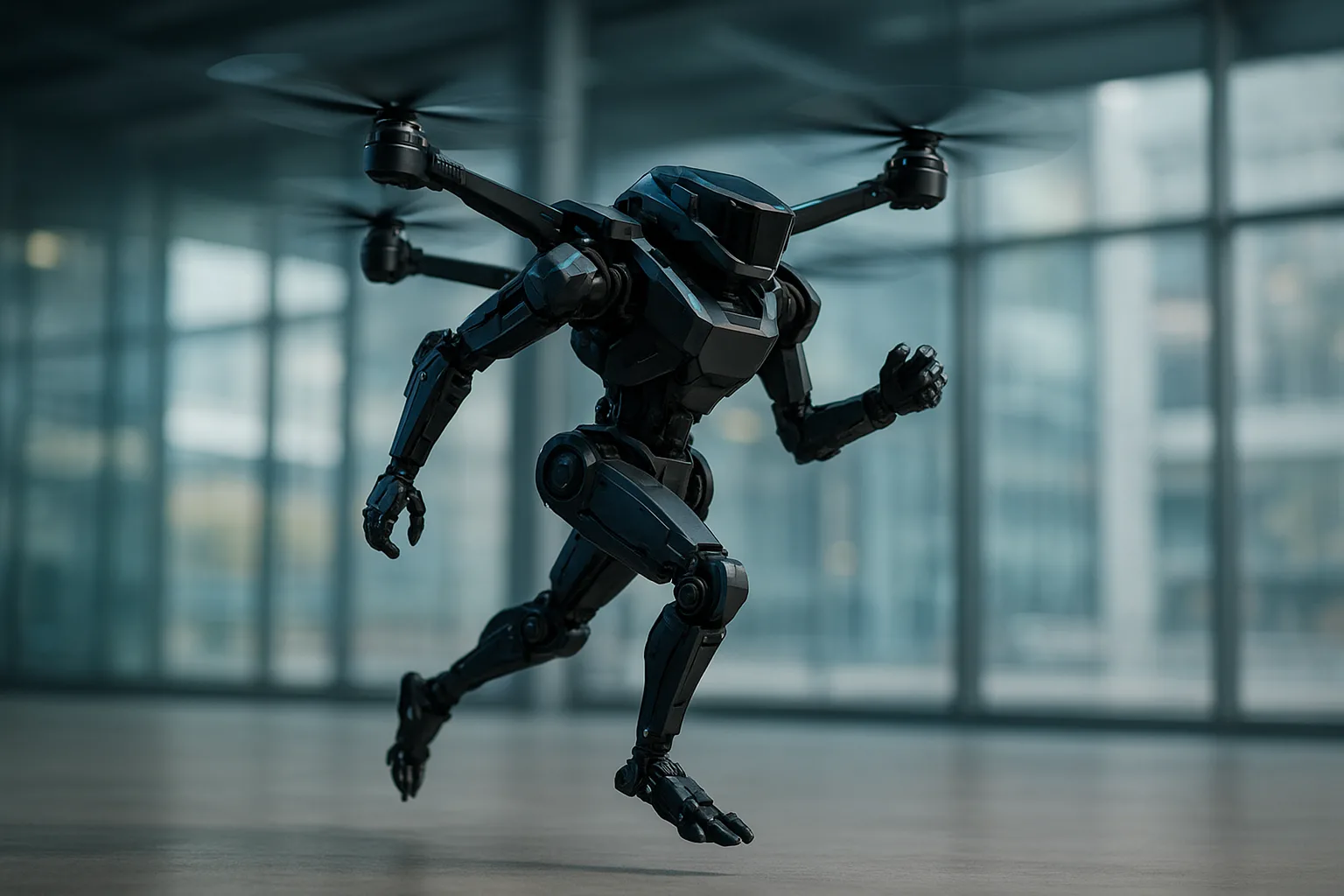
Caltech has done it again. The university’s engineers have built a robot that doesn’t just walk or fly — it can do both. And it’s smart enough to decide when to use each mode. This breakthrough brings robotics closer than ever to matching human adaptability, and maybe even surpassing it.
Meet the Hybrid Marvel
The robot, called LEONARDO (LEgs ONboARD drOne), isn’t your average machine. It walks like a bird, balances like a gymnast, and takes off like a drone.
Caltech’s team designed it to master both terrestrial and aerial movement, letting it move efficiently in environments where wheels or propellers alone wouldn’t cut it.
With carbon-fiber legs, rotors for flight, and an onboard AI brain, LEONARDO learns how to balance, walk, and fly — all on its own.
Walking, Flying, and Thinking — All at Once
Unlike traditional robots, LEONARDO doesn’t need humans to tell it when to switch modes. It analyzes its surroundings in real time.
If it encounters stairs, uneven terrain, or obstacles, it decides whether to walk, jump, or hover. That’s the kind of adaptability that makes this robot feel more like a living creature than a machine.
This blend of AI perception and robotic mechanics could redefine how robots explore places humans can’t — from disaster zones to other planets.
Why This Robot Is a Big Deal
Caltech’s creation isn’t just about speed or flexibility. It’s about versatility and intelligence.
By combining two forms of movement — walking and flying — the robot opens up possibilities for missions in rough terrains, tight spaces, or unstable structures.
Think of it as a mix between a drone, a dog, and a human athlete — one that can analyze, adapt, and act in seconds.
A Leap Forward for Robotics
The Caltech team believes robots like LEONARDO could transform industries — from search and rescue to space exploration.
On Earth, they could help during natural disasters, flying over debris and walking through wreckage. In space, they could explore planets like Mars, where uneven terrain makes wheeled rovers struggle.
And as AI continues to evolve, these hybrid robots could soon collaborate with humans — not just follow commands.
Outrunning and Outsmarting Us? Maybe Soon
Right now, LEONARDO is still a research prototype. But its design marks a massive step toward the kind of robots science fiction promised.
Fast, flexible, and intelligent — this Caltech creation hints at a future where machines don’t just move; they learn how to move better than we do.
The line between human agility and robotic intelligence is fading — and Caltech’s new robot just made it blurrier than ever.


Leave a Reply